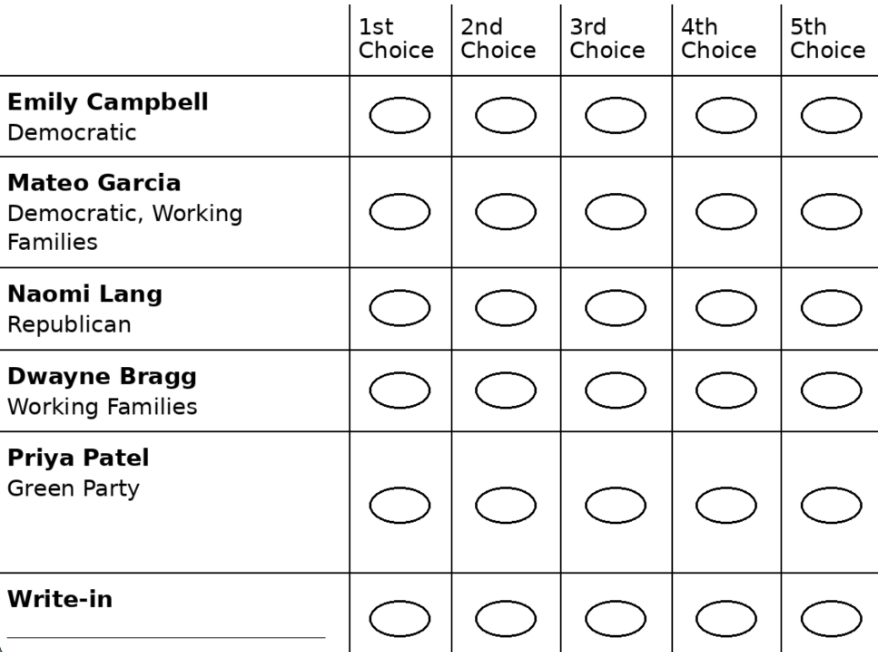
The RCV Albany ballot proposal aims to change our city election system to “Ranked Choice Voting in a Single Unified Election,” meaning that instead of a closed June primary followed by a November general election, there would be a single ranked choice November election that includes all voters and all candidates.
Why a Single Unified Election?
- Every single registered voter gets a voice. In Albany, thousands of registered voters cannot participate in primary elections that often determine who gets elected. Unaffiliated voters or those registered with third parties make up 1/4th of the voting population.
- It’s simpler. One election for all registered voters. One timeline for candidates to knock doors, gather signatures, and mail flyers. Not enough candidates run in Albany to merit two separate elections: the primaries are competitive and November is a formality.
- Better representation when combined with RCV: research shows that RCV elections open to all voters better represent the electorate, resulting in the election of more women and underrepresented groups.
- It saves taxpayer money. One election instead of two means lower costs for the City of Albany.
How does this differ from the Ranked Choice Voting approach in New York City?
RCV in New York City, utilized for the first time in 2021, is only used in the closed June primaries. It has great benefits in those elections, such as encouraging more candidates to run and campaigns to be less negative and more collaborative, and voters that used it wanted to use it again.
However, the system has major gaps:
- There is no RCV in the general election, so more than two candidates running in November has the potential to spoil the election.
- The 1.2 million unaffiliated NYC voters are not allowed to vote in the June primaries.
NYC’s model is actually completely unique nationwide: the vast majority of US cities with ranked choice elections hold a single election, including:
- Minneapolis, MN
- St. Paul, MN
- San Francisco, CA
- Oakland, CA
- Boulder, CO
- Salt Lake City, UT
- Santa Fe, NM
Who are the unaffiliated voters in Albany?
Unaffiliated voters in Albany are just as racially diverse as the rest of Albany, and have similar political leanings on a right-left spectrum. However, they skew younger than other voters (most first-time registrants don’t register with a party), are more likely to be veterans, and may have views that don’t fit neatly into one of two party boxes.
See the map below for an illustration of unaffiliated population by ward and how it maps onto racial demographics:

How does the proposal incorporate New York’s fusion voting system?
Instead of parties having ballot lines with candidate names listed multiple times, each candidate will be listed one time with their registered party as well as any parties they mutually agree to appear with. The exact formatting will be up to election administrators, but here is what a sample general election ballot could look like: